
NAPIT Welcomes Budget Announcements for its Members
29 October 2026
NAPIT has welcomed announcements in the Government’s Budget 2026 that could help reduce household energy costs and create new opportunities for electricians and installers of low-carbon technology.
The certification body and training provider represents more than 22,000 members working as electricians and installers of low-carbon technologies across the UK.
The Budget includes measures to support household energy bills, reduce the cost of electric vehicle charging, extend fuel duty relief and encourage investment in energy-saving technologies.
For NAPIT members working across electrical installation, solar PV, battery storage, EV charging and heat pumps, these measures could help stimulate demand and support business growth.
The Government has confirmed £400 million in funding for the Boiler Upgrade Scheme in 2027/28. However, this is below the £600 million previously set out for that year in the Warm Homes Plan, raising questions about the future scale of support for heat-pump installations and the implications for installers and consumers.
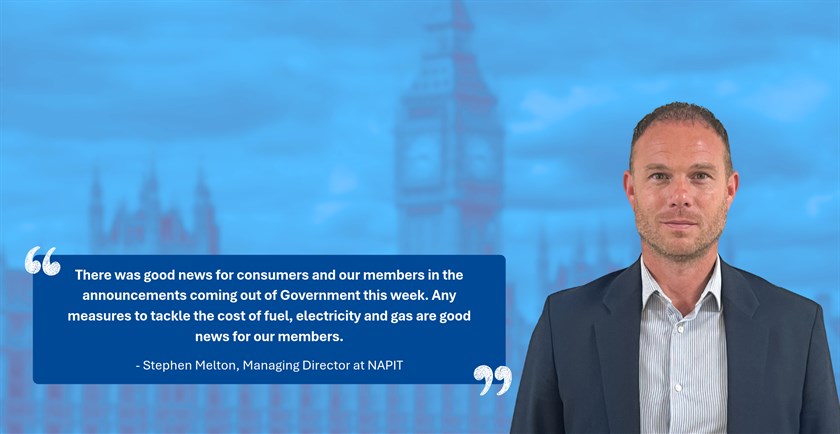
NAPIT Managing Director Stephen Melton said: “There was good news for consumers and our members in the announcements coming out of Government this week.
“Any measures to tackle the cost of fuel, electricity and gas are good news for our members.
“The announcement of the no-and low-interest loans through the Warm Homes Loans Scheme is particularly welcome. The scheme offers loans of up to £15,000 for solar panels and electrical storage batteries, up to £20,000 for an air-to-water heat pump and up to £10,000 for air-to-air heat pumps.
“The Budget also confirmed continued funding for the Boiler Upgrade Scheme, which supports households in England and Wales to install heat pumps, although it does appear to be at a lower level than previously announced.
“This is an important commitment for consumers and installers alike, providing continuity for a scheme that helps households make the transition to low-carbon heating. NAPIT will continue to monitor the scheme’s future funding and its implications for installers and consumers.
“The Prime Minister talks about wanting to create growth in every postcode, and our members who have the necessary skills to install these technologies will be able to take advantage of those growth opportunities.”
The Warm Homes Loans Scheme is designed to help households overcome the upfront cost of installing clean energy technologies by spreading payments over time. The scheme is intended to be available to households across England, Scotland, Wales and Northern Ireland, with some loans offering interest-free borrowing.
Homeowners may also be able to combine eligible loans with grants of up to £9,000 through the Boiler Upgrade Scheme in England and Wales, or access support through Home Energy Scotland, to reduce the cost of installing a heat pump.
NAPIT believes that making these technologies more accessible could help increase the number of households investing in solar PV, battery storage and low-carbon heating, creating further opportunities for competent installers.
NAPIT is keen to understand the detailed arrangements for the Warm Homes Loans Scheme, including eligibility criteria, delivery arrangements and the requirements placed on participating installers.
Any scheme designed to stimulate demand must ensure that consumers can identify competent installers and have confidence that work is carried out safely, to the appropriate standards and with effective consumer protection.
Other Budget announcements include a £100 Household Energy Payment for eligible households in England in council tax bands A to D, with funding provided to devolved administrations to support households elsewhere in the UK.
The temporary zero rate of VAT on qualifying domestic electricity supplies will also be extended until 1 July 2027. The Government has asked Ofgem to abolish domestic gas standing charges and move these costs into unit rates, with further details to follow.
For electric vehicle drivers, the Government has announced £100 million over two years to reduce the cost of using local, lower-powered public charging points. The funding is expected to save drivers who rely on on-street charging around £150 a year on average, with changes due to begin in spring 2027.
The temporary 5p-per-litre fuel duty cut will also be extended for a further six months, until 1 July 2027.
NAPIT recognises that energy and transport costs affect both households and the businesses that serve them. Measures that improve affordability, alongside support for low-carbon technologies, could help create the conditions for further growth across the installation sector.
As the Government seeks to accelerate home energy improvements and electrification, the availability of a skilled and competent workforce will remain critical.
Ensuring that consumers can identify qualified installers, have confidence in the quality of work and benefit from effective consumer protection will be essential to the success of programmes intended to increase the uptake of low-carbon technologies.
NAPIT also recognises that electrical contractors, particularly sole traders and smaller businesses, continue to face pressures from operating costs, workforce requirements and the need to invest in skills and equipment. The planned increase in the National Living Wage will need to be considered by employers when planning staffing and wage budgets.
NAPIT believes that policies designed to expand the market for low-carbon technologies must be accompanied by a realistic assessment of the costs faced by the small businesses responsible for delivering these installations.
The organisation will continue to engage with Government and industry stakeholders to ensure that the experience of installers is reflected in the development and delivery of policies affecting the sector.
